Here’s a surprisingly positive truth: your dental practice is already sitting on one of the most powerful growth tools available – and it’s probably underused. Your patient database, when paired with smart email marketing automation, can consistently generate appointments, increase treatment acceptance, and strengthen long-term relationships.
Now for the uncomfortable question: if email marketing is so effective, why do so many dental practices still rely on random reminders, outdated newsletters, or worse – no communication at all? Even more ironic, some practices spend heavily on ads to attract new patients while completely ignoring the ones they already have.
That’s not just inefficient – it’s a missed opportunity.
In 2026, email marketing automation is no longer optional. It’s a structured, data-driven system that works quietly in the background, guiding patients from awareness to action. When done right, it becomes one of the highest ROI channels in your entire marketing strategy.
Let’s break down exactly how it works – and how to implement it effectively.
Why Email Marketing Still Dominates in 2026
Despite the rise of social media and paid advertising, email remains one of the most reliable communication channels.
Why?
Because:
- It reaches patients directly
- It allows personalization at scale
- It supports automation and consistency
- It delivers measurable results
Unlike social platforms where visibility fluctuates, email gives you control. You’re not competing with algorithms – you’re communicating directly with your audience.
For dentists, this means:
- Higher appointment retention
- Increased case acceptance
- Better patient engagement
When paired with automation, email becomes a system – not a task.
What Is Email Marketing Automation?
Email marketing automation is the process of sending pre-designed, triggered emails based on patient behavior, timing, or specific actions.
Instead of manually sending messages, you create workflows that operate automatically.
Examples include:
- Welcome sequences for new patients
- Appointment reminders
- Post-treatment follow-ups
- Re-engagement campaigns
This ensures consistent communication without increasing workload.
Automation isn’t about sending more emails – it’s about sending the right emails at the right time.
The Welcome Series: Your First Impression That Lasts
The moment a new patient connects with your practice is critical.
A well-designed welcome series sets expectations, builds trust, and increases the likelihood of long-term engagement.
An effective welcome sequence typically includes:
- Introduction Email
- Thank the patient
- Introduce your practice
- Reinforce your values
- What to Expect
- Explain your process
- Highlight patient experience
- Reduce uncertainty
- Educational Content
- Share oral health tips
- Position your expertise
- Call to Action
- Encourage appointment booking
- Provide clear next steps
This sequence transforms a simple inquiry into a meaningful connection.
Appointment Reminders: Reducing No-Shows
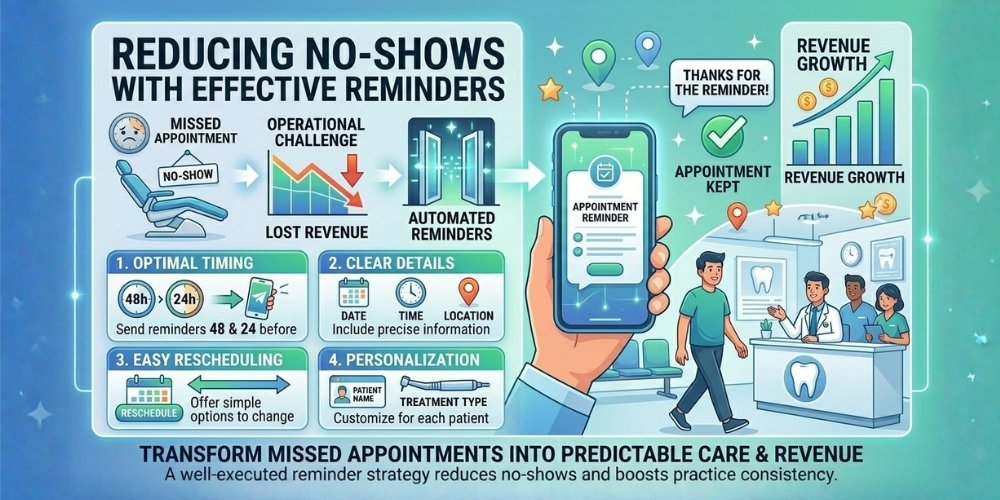
Missed appointments are one of the biggest operational challenges in dentistry.
Automated reminders significantly reduce no-shows.
Best practices include:
- Sending reminders 48 hours and 24 hours before the appointment
- Including clear details (date, time, location)
- Offering easy rescheduling options
Adding personalization – such as the patient’s name and treatment type – further improves effectiveness.
Consistency here directly impacts revenue.
Post-Appointment Follow-Ups: Strengthening Relationships
Communication shouldn’t stop after the appointment.
Post-visit emails help:
- Reinforce trust
- Provide care instructions
- Encourage feedback
These emails can include:
- Thank-you messages
- Post-treatment care tips
- Review requests
This not only improves patient experience but also increases online reputation through reviews.
Re-Engagement Campaigns: Bringing Patients Back
Every practice has inactive patients.
Instead of letting them disappear, automation allows you to reconnect.
Re-engagement campaigns target:
- Patients who haven’t visited in 6–12 months
- Missed follow-ups
- Incomplete treatments
Effective emails include:
- Friendly reminders
- Special offers or incentives
- Educational content
The goal is simple: bring them back into your care cycle.
Personalization: The Key to Higher Engagement
Generic emails rarely perform well.
Patients expect communication that feels relevant.
Personalization can include:
- Name and appointment history
- Treatment recommendations
- Location-based messaging
Advanced systems use behavior data to tailor content.
For example:
- Sending implant information to patients who viewed implant pages
- Sharing whitening offers with cosmetic-focused patients
Relevance increases engagement – and engagement drives action.
Segmentation: Sending the Right Message to the Right Audience
Not all patients are the same.
Segmentation allows you to group patients based on:
- Age
- Treatment history
- Interests
- Appointment frequency
This ensures that each email is targeted and meaningful.
For example:
- Preventive care reminders for regular patients
- Educational content for new leads
- High-value treatment campaigns for interested prospects
Segmentation improves both open rates and conversions.
Timing and Frequency: Finding the Balance
Too many emails can overwhelm patients. Too few can make them forget you.
The key is balance.
Best practices:
- Maintain consistent but non-intrusive communication
- Align emails with patient needs and timelines
- Avoid sending irrelevant content
Automation helps maintain this balance effortlessly.
Integrating Email with SEO and Digital Marketing
Email marketing doesn’t operate in isolation.
It works best when integrated with:
- SEO strategies
- Social media marketing
- Digital advertising
For example:
- SEO drives traffic to your website
- Email nurtures that traffic
- Ads retarget engaged users
This creates a complete patient journey – from discovery to conversion.
Measuring Success: Data-Driven Optimization
One of the biggest advantages of email marketing is measurability.
Key metrics include:
- Open rates
- Click-through rates
- Conversion rates
- Appointment bookings
Analyzing this data helps you:
- Refine messaging
- Improve timing
- Optimize performance
Growth becomes predictable when decisions are data-driven.
Common Mistakes to Avoid
Many practices fail to see results because of simple mistakes.
These include:
- Sending generic, non-personalized emails
- Overloading patients with too many messages
- Ignoring segmentation
- Lack of clear calls-to-action
Avoiding these pitfalls ensures your automation system works effectively.
The Role of Content in Email Marketing
Content is what keeps patients engaged.
Effective email content includes:
- Oral health tips
- Treatment insights
- Preventive care advice
- Updates about your practice
This positions your practice as a trusted resource – not just a service provider.
Automation as a Long-Term Growth System
Email automation isn’t a short-term tactic – it’s a long-term strategy.
Benefits include:
- Consistent patient communication
- Increased retention
- Higher treatment acceptance
- Improved operational efficiency
Once set up, it continues to deliver results with minimal effort.
Why Most Dental Practices Underutilize Email
Despite its benefits, many practices:
- Use email only for reminders
- Lack structured workflows
- Ignore personalization
This limits potential.
A strategic approach unlocks real growth.
How Digital Presence Matters Elevates Email Marketing
This is where expert guidance makes a difference.
Digital Presence Matters helps dental practices build advanced email automation systems that integrate seamlessly with their overall marketing strategy.
Their approach includes:
- Creating targeted email workflows for welcome series, reminders, and re-engagement
- Producing high-quality video content that can be embedded in emails to boost engagement
- Aligning email campaigns with social media marketing for consistent messaging
- Using digital advertising to complement email nurturing
- Implementing SEO strategies that drive traffic into email funnels
- Enhancing websites to capture leads effectively and convert them into subscribers
Instead of treating email as a standalone tool, they build a connected ecosystem.
For example, a patient who visits your website through SEO can enter an automated email sequence, watch a video explaining treatments, and eventually book an appointment – all without manual intervention.
This integration transforms email marketing into a powerful growth engine.
Turning Emails into Appointments
When done correctly, email marketing automation:
- Keeps your practice top-of-mind
- Builds trust over time
- Encourages timely action
Patients move from awareness to decision seamlessly.
The Competitive Advantage
Most dental practices still rely on basic communication methods.
This creates an opportunity.
By implementing advanced email automation, you:
- Stand out
- Improve patient experience
- Increase revenue
- Build long-term loyalty
The difference lies in strategy.
Conclusion
Email marketing automation is not just about sending messages – it’s about guiding patient behavior.
When structured correctly, it:
- Strengthens relationships
- Improves retention
- Drives consistent growth
In 2026, it’s one of the most effective tools available.
Remember
- Automation ensures consistent communication without added workload.
- Personalization and segmentation significantly improve engagement.
- Email works best when integrated with a broader digital strategy.
Disclaimer
This content is intended for informational and marketing purposes only and should not be considered professional, legal, or financial advice. Results may vary depending on individual practice strategies and implementation.
Ready to transform your patient communication with powerful email automation?
Reach out today:Email: Info@digitalpresencematters.com
Phone: (925) 940-0705